Bulgaria's Euro Adoption: What Actually Changed for Companies in 2026
Bulgaria switched to the euro on 1 January 2026. What it changed for company owners in practice: the automatic conversions, the two deadlines still ahead, and the 2026 numbers most sites still get wrong.
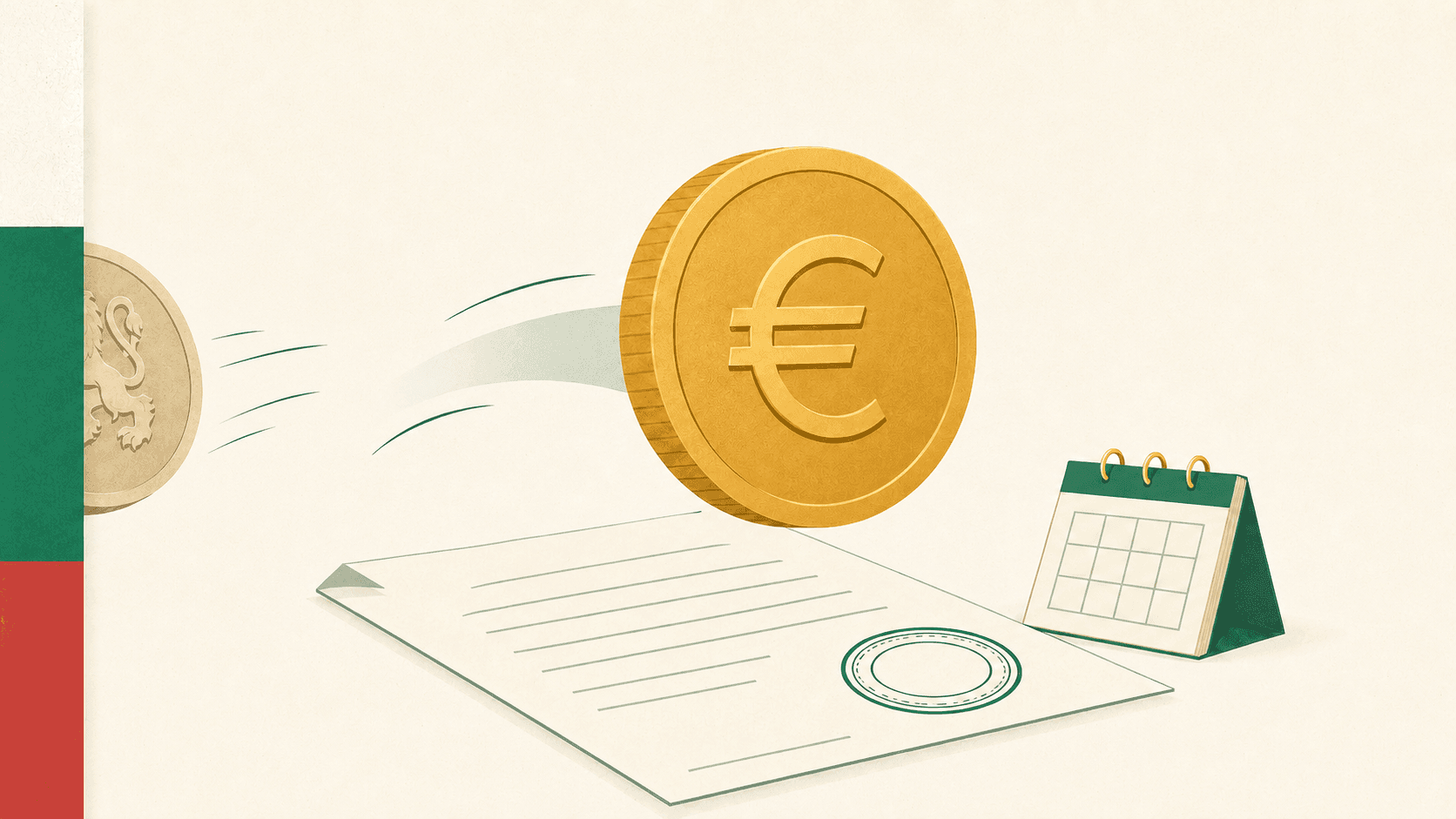
On 1 January 2026 Bulgaria became the 21st member of the euro area. The lev is gone, the conversion rate was fixed forever at 1.95583 leva per euro, and every guide you will find about it was written before the switch happened. This one is written from the other side. We run our own Bulgarian EOOD, our accounts and capital went through the changeover along with everyone else's, and seven months in, the picture is clear: almost everything happened automatically, two deadlines are still ticking, and several numbers you will read on formation-agency websites are now simply wrong.
The two things still on the clock
1. Update your company documents by 31 December 2026. The Registry Agency converted every company's registered capital from leva to euro on its own on 1 January, with no application and no fee. The commercial register already shows your capital in euro. But the conversion did not rewrite your articles of association, and those still say leva. Companies must file updated constitutive documents: an EOOD or OOD attaches them to its next register filing, or by 31 December 2026 at the latest, and joint-stock companies file the updated statute for publication by the same date. The filing is free and, for a pure currency restatement, generally needs no shareholder resolution. Miss it and there is no automatic fine that we could confirm, but the register will block your next filing until the documents are in order, which is exactly the kind of surprise you do not want in the middle of a bank refinancing or a share transfer.
2. Dual price display ends 8 August 2026. Since 8 August 2025, anyone selling to consumers in Bulgaria has had to show prices in both currencies, same font, same size. That obligation, and the state's parallel control over unjustified price increases, both run out on 8 August 2026. If your company invoices foreign B2B clients, this whole topic largely never applied to you. If you run anything consumer-facing in Bulgaria, take the last stretch seriously: by mid-April regulators had already imposed over EUR 1 million in penalties for changeover-related price violations.
What happened without you doing anything
The changeover was designed so that a normal company owner had almost no to-do list, and that is genuinely how it played out.
Bank accounts converted themselves. Every lev account became a euro account on 1 January, free, at the fixed rate, and IBANs did not change. Lev clearing was switched off and domestic payments now run as SEPA transfers, which means a transfer from a German or Dutch client reaches a Bulgarian business account the same way a domestic one does. For a company selling across the EU, the single biggest practical win of the whole changeover is invisible: the currency conversion line item is gone from your books.
Contracts survived untouched. The law carried over every existing legal instrument: a contract written in leva stays valid and its amounts are simply read in euro at the fixed rate. Neither side can renegotiate or walk away because of the changeover.
Outstanding tax balances were converted by the revenue agency, and payments to it have been euro-only since January.
The numbers as they actually stand in 2026
This table is the part we wish had existed in January. Plenty of sites still quote figures that died with the lev, or before it.
| Item | 2026 reality |
|---|---|
| Corporate income tax | 10 percent, unchanged |
| Dividend withholding tax | 5 percent, unchanged |
| VAT registration threshold | EUR 51,130 per calendar year |
| Minimum capital, EOOD or OOD | EUR 1 (minimum share EUR 0.01) |
| Minimum capital, AD (joint-stock) | EUR 25,000 |
| Cash payment ceiling | EUR 5,112.92 per transaction |
| Cash dividends | Not allowed above EUR 511.29, bank transfer required |
| Commercial Register e-filing fee, new EOOD | About EUR 28 |
Three footnotes worth the space. The VAT threshold you will still see quoted as 166,000 leva was reverted in April 2025 and is now EUR 51,130 in the law itself. The EOOD minimum capital went from 2 leva, which converts to EUR 1.02, to a clean EUR 1, and the joint-stock minimum was quietly cut from the converted EUR 25,564.59 to a round EUR 25,000, so founding got marginally cheaper on both counts. And the dividend tax has a story: the 2026 draft budget proposed doubling it to 10 percent, the proposal helped trigger street protests, the budget was withdrawn, the government resigned, and the 5 percent rate stands for all of 2026. Anyone who tells you Bulgarian tax rates never get challenged is selling something, but this round, the low-tax status quo won.
The accounting seam between 2025 and 2026
Your books switched to euro on 1 January 2026, with opening balances converted at the fixed rate. The seam is in the filings: the 2025 annual financial statements and the 2025 corporate tax return were prepared in leva, because they cover a lev year, and were filed during 2026. From financial year 2026 everything is in euro, with prior-year comparatives recalculated. There are fiddly rules for documents that cross the boundary, like a January credit note against a December invoice, and for where rounding differences land. This is squarely your accountant's job; ours handled it without drama. What you should do is exactly one thing: when you get your 2026 statements, check the comparatives are in euro and the capital matches what the register shows.
If you still have leva
Cash dual circulation ended on 31 January 2026. Commercial banks exchanged leva free of charge until 30 June 2026, and since 1 July they are allowed to charge for it. The Bulgarian National Bank exchanges banknotes and coins at the fixed rate, free, with no end date. So nothing is lost if you find a drawer of leva in 2030, but the convenient free option at your local branch is already over.
What this means if you are forming a company now
For a foreign founder the changeover removed friction rather than adding it. You state your capital in euro from day one, from EUR 1. Your Bulgarian company banks in the same currency as your eurozone clients and suppliers, on SEPA rails. And the two numbers that bring most founders here, 10 percent corporate tax and 5 percent on dividends, came through the euro transition and a collapsed budget intact. If you want a straight answer on whether a Bulgarian EOOD fits your situation, ask us and you will get one, including when the answer is no.
General information based on rules as of July 2026, not legal or tax advice. Verify current requirements with a licensed professional before acting. Sources: ECB press releases on Bulgaria's euro area accession (8 July 2025 and 1 January 2026); Bulgarian National Bank euro FAQ on dual price display; Ministry of Finance instructions on accounting documentation for the euro changeover (evroto.bg); PwC Tax Summaries, Bulgaria (2026); Schoenherr and CMS client briefings on the mandatory euro conversion of company capital; BTA reporting on changeover price-control penalties (April 2026).
Related articles

Opening a Business Bank Account for a Bulgarian EOOD as a Non-Resident (2026)
What a non-resident actually faces opening a Bulgarian business bank account in 2026: capital account vs operating account, real fees from four tariffs, and why banks refuse.
Company Formation in Bulgaria: What It Actually Costs in 2026
The real cost of forming a Bulgarian company in 2026: official Registry Agency fees (about 35 euros), what the 140 to 1,950 euro packages actually contain, the foreigner overlay, and two checks nobody mentions.

Running a Bulgarian EOOD: What It Actually Looks Like
What running a Bulgarian EOOD involves in practice: the real tax math, the monthly accounting rhythm, what it costs, and the parts formation agencies tend to skip.